Breed History
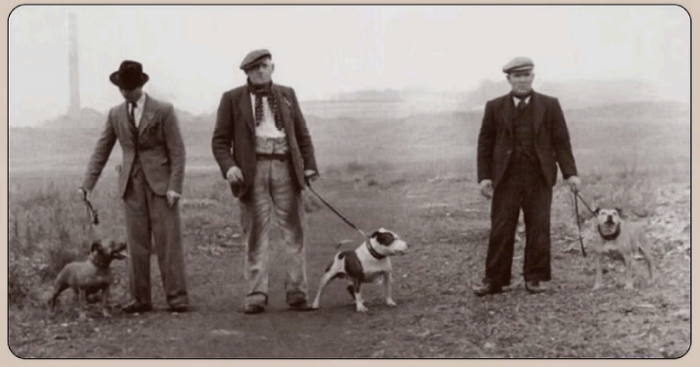
Before the nineteenth century, blood sports such as bull baiting, bear baiting and cock fighting were common. Bulls bought to market were set upon by dogs as a way of tenderizing the meat and providing entertainment for the spectators; and dog fights with bears, bulls and other animals were often organized as entertainment for both royalty and commoners. Early Bull and Terriers were not bred for the handsome visual specimen of today, rather they were bred for the characteristic known as gameness. The pitting of dogs against bear or bull tested the gameness, strength and skill of the dog. These early "proto-Staffords" provided the ancestral foundation stock for the Staffordshire Bull Terrier, the American Pit Bull Terrier with the exception of the American Staffordshire Terrier.
These blood sports were officially eliminated in 1835 as Britain began to introduce animal welfare laws. Since dogfights were cheaper to organize and far easier to conceal from the law than bull or bear baits, blood sport proponents turned to pitting their dogs one against another instead. Dog fighting was used as both a blood sport (often involving gambling) and as an effort to continue to test the quality of their stock. For decades afterwards, dog fighting clandestinely took place in pockets of working-class Britain and America. Dogs were released in a pit, and the last dog still fighting (or occasionally, the last dog surviving) was recognized as the winner. The quality of pluckiness or "gameness" was still highly prized, and dogs that gave up during a fight were reviled as "curs". As an important aside, fighting dogs were often handled in the pit during fights, by both their owners and the judge, so were bred to be as trustworthy with humans as they were aggressive towards other dogs.
It is this nefarious history that gives the Stafford his celebrated temperament, as in the words of the American Kennel Club: "from the past history of the Staffordshire Terrier, the modern dog draws its character of indomitable courage, high intelligence, and tenacity. This, coupled with its affection for its friends, and children in particular, its off-duty quietness and trustworthy stability, makes it a foremost all-purpose dog"
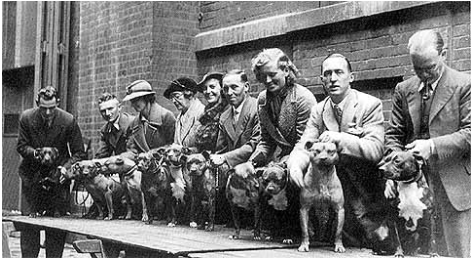
The breed attained UK Kennel Club recognition on 25 May 1935. Much of the groundwork to attain this status can be attributed to Joseph Dunn and Joe Mallen. Dunn and Mallen invited friends to a Stafford fanciers meeting at the Cross Guns Hotel, Cradley Heath, South Staffordshire (a hotel owned and managed by Mallen). About fifty breeders met at the hotel and formed the Original Staffordshire Terrier Club. The name was shortly changed to Staffordshire Terrier Club due to the Bull Terrier Club objecting the use of the word 'original'.
Staffords now rank among the most popular Terrier races. They are courageous, reliable, sociable dogs, devoted and good-natured.